What Is FedEx SmartPost? Complete 2026 Guide to FedEx Ground Economy
If you’ve recently seen the term FedEx SmartPost on a shipping label, tracking page, or online order, you may wonder what it actually means. Is SmartPost still a FedEx service? How does it work, how long does it take, and who is it designed for?
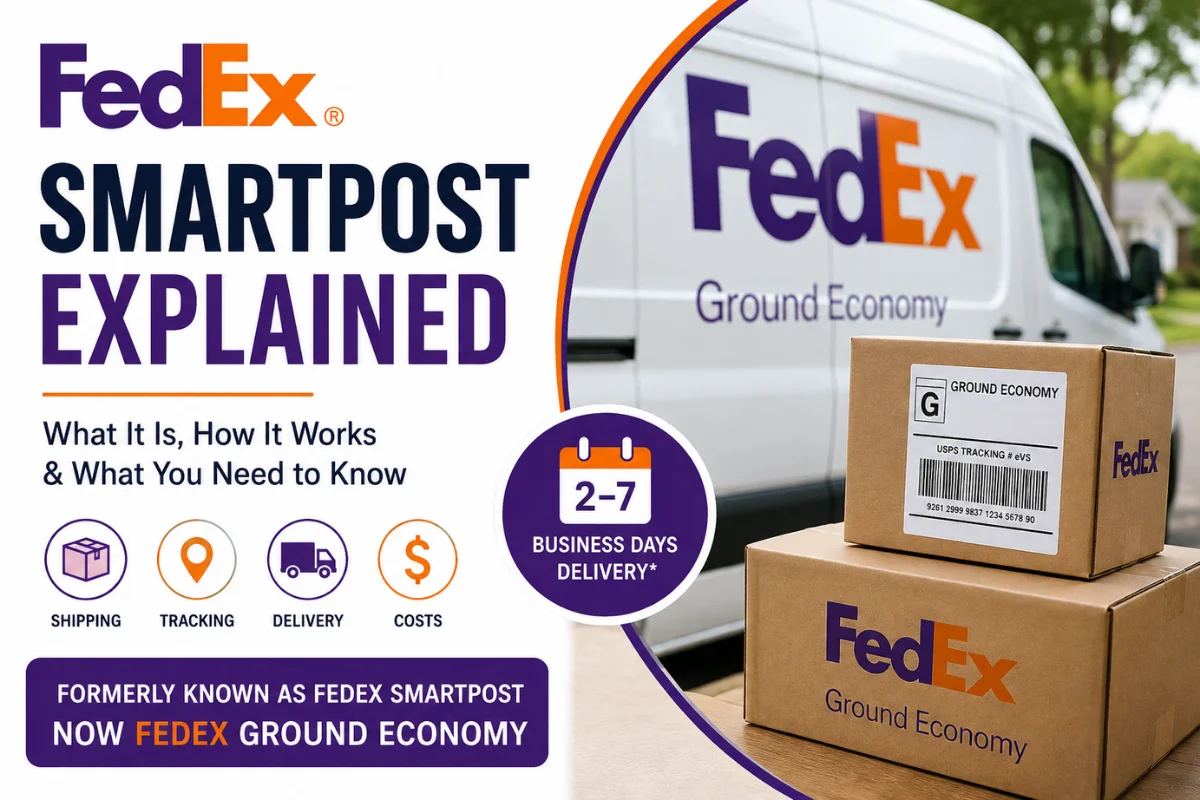
The short answer is that FedEx SmartPost is the former name of FedEx Ground Economy, a cost-effective shipping service designed primarily for low-weight, non-urgent, high-volume residential shipments. FedEx officially changed the name to FedEx Ground Economy in March 2021, but the SmartPost name can still appear in some merchant systems, older labels, and shipping software. The service itself continues under the Ground Economy name.
FedEx Ground Economy is particularly useful for businesses that send a large number of lightweight packages and want an economical delivery option rather than an expedited service. The service uses the FedEx Ground network and can involve the United States Postal Service (USPS) for final residential delivery.
Let’s take a closer look at how FedEx SmartPost became FedEx Ground Economy, how the service works, its delivery times, tracking, package requirements, and whether it’s the right option for your shipment.
Is FedEx SmartPost Still Available?
Yes, but FedEx SmartPost is no longer the current service name.
FedEx renamed SmartPost to FedEx Ground Economy in March 2021. According to FedEx, customers may still encounter preprinted labels carrying the SmartPost name, while some merchants and older shipping systems may continue to display it during checkout. The underlying service details remain associated with the renamed Ground Economy service.
This explains why people still search for FedEx SmartPost, FedEx Smart Post, and what is FedEx SmartPost even though the current FedEx terminology is Ground Economy.
FedEx’s developer documentation also continues to identify Ground Economy as the service formerly known as SmartPost, so seeing both names in shipping technology or tracking systems does not necessarily indicate that you have selected two different services.
What Is FedEx Ground Economy?
FedEx Ground Economy is a contractual shipping service intended for low-weight, non-time-critical business-to-consumer packages.
Instead of paying for an expedited service, businesses can use Ground Economy when keeping shipping costs down is more important than getting a package delivered as quickly as possible.
The service is especially relevant to eCommerce businesses that send many relatively small packages to residential customers.
How FedEx Ground Economy Works
The shipping process generally involves several stages.
First, FedEx receives and processes the package through its network. The shipment is then transported toward its destination using the FedEx Ground network. For eligible residential shipments, USPS can handle the final delivery to the recipient’s address.
This combination gives businesses access to a cost-conscious delivery model while maintaining shipment visibility.
The process can be summarized as:
- The merchant creates the shipment.
- FedEx receives and processes the package.
- The package moves through the FedEx Ground network.
- The shipment is transported toward the destination.
- USPS may handle the final residential delivery.
- The package is delivered to the recipient.
The exact routing can depend on the shipment and service requirements.
FedEx SmartPost vs. FedEx Ground Economy
The most important distinction is simple: SmartPost is the old name, while Ground Economy is the current name.
| Feature | FedEx SmartPost | FedEx Ground Economy |
| Current name | Former service name | Current service name |
| Primary use | Low-weight, non-urgent shipments | Low-weight, non-urgent shipments |
| Target customers | Primarily high-volume shippers | Businesses and qualifying shippers |
| Residential delivery | Yes | Yes |
| USPS involvement | May be used for final delivery | May be used for final delivery |
| Tracking | Available | Available |
| Current branding | Legacy references may remain | Current FedEx branding |
| Contract | Associated with contractual service | Contractual service |
FedEx’s current documentation confirms that Ground Economy and SmartPost are treated as the same service for relevant terms and that existing SmartPost contracts remained active following the renaming.
How Long Does FedEx Ground Economy Take?
Delivery time depends on the origin, destination, package characteristics, and other shipping conditions.
FedEx’s customer-facing information generally describes Ground Economy as a lower-cost service rather than an expedited option. FedEx’s Spanish-language service page currently states that Ground Economy deliveries typically take 2 to 7 business days, depending on distance and other circumstances.
Because it is designed for non-urgent shipments, customers should not generally choose Ground Economy when a package must arrive by a very specific deadline.
For urgent shipments, FedEx offers faster services designed around defined delivery commitments.
Why Delivery Can Take Longer
Several factors can influence the final delivery date, including:
- Distance between origin and destination
- Weekends and holidays
- Weather conditions
- Transportation disruptions
- Address issues
- Processing delays
- USPS final-mile delivery
For this reason, the estimated delivery date should be treated as the useful guide for the individual shipment rather than assuming every Ground Economy package will arrive in exactly the same number of days.
FedEx SmartPost Tracking
One of the common questions from customers is how to track a package that still says FedEx SmartPost.
The good news is that the old service name does not mean the shipment cannot be tracked.
FedEx introduced an updated Ground Economy label that prominently includes a FedEx tracking number. The updated labeling was designed to make it easier for recipients to identify the carrier and obtain tracking information. FedEx also continued to include USPS tracking information for applicable shipments.
If your label or order confirmation contains a FedEx tracking number, enter it through FedEx’s official tracking system.
For some shipments, you may also see USPS-related tracking information because of the final-mile delivery arrangement.
Why Are There Two Tracking Numbers?
A Ground Economy shipment can contain both FedEx and USPS tracking information.
FedEx documentation explains that the service’s labels can contain a FedEx tracking number as well as a USPS tracking number or barcode.
This doesn’t necessarily indicate a problem. Instead, it can reflect the different stages of transportation and final delivery.
What Packages Are Suitable for FedEx Ground Economy?
Ground Economy is intended primarily for lightweight, non-urgent packages.
Current FedEx developer documentation lists a maximum single-package weight of 70 pounds (32 kg) for customer-packaged Ground Economy shipments.
However, weight is only one part of determining whether a shipment qualifies. FedEx service restrictions, package characteristics, origin, destination, and the shipper’s agreement can also affect eligibility.
Ground Economy is particularly suited to products commonly purchased online, including many small consumer goods.
Common Examples
Businesses may use an economical residential shipping service for items such as:
- Clothing
- Accessories
- Books
- Small household products
- Retail merchandise
- Non-urgent eCommerce orders
- Lightweight consumer goods
The best service depends on the shipment’s weight, dimensions, destination, urgency, and business requirements.
Is FedEx Ground Economy Available to P.O. Boxes?
One useful feature of Ground Economy is its support for residential deliveries, including P.O. boxes and certain military destinations, according to FedEx’s developer documentation.
This can make the service particularly useful for businesses serving customers who do not receive packages at traditional street addresses.
However, shippers should always check the current service rules for the specific shipment because eligibility and restrictions can vary.
Who Uses FedEx Ground Economy?
Ground Economy is particularly useful for businesses with recurring residential shipments.
eCommerce Businesses
Online stores often need to balance customer expectations with shipping costs. When an order isn’t urgent, an economical ground service can help control fulfillment expenses.
High-Volume Shippers
Ground Economy was designed around consolidating low-weight packages, making it suitable for businesses that process substantial numbers of residential shipments.
Businesses Offering Free or Low-Cost Shipping
Shipping fees can influence whether customers complete an online purchase. A lower-cost delivery option can help merchants manage fulfillment expenses while still offering delivery to residential customers.
Is FedEx SmartPost Cheaper Than Regular FedEx?
Because SmartPost is now Ground Economy, comparisons should be made between FedEx Ground Economy and other current FedEx services, rather than treating SmartPost as a separate active product.
Ground Economy is designed as a cost-effective option for low-weight, non-urgent residential shipments. That means it can make sense when delivery speed is less important than controlling transportation costs.
However, there isn’t one universal price for every package.
Shipping costs can depend on factors such as:
- Package weight
- Package dimensions
- Origin
- Destination
- Shipping volume
- Contract terms
- Service requirements
- Additional fees
Businesses should compare their actual rates rather than assuming one service will always be cheaper.
FedEx Ground Economy Returns
FedEx also offers Ground Economy Returns, which are designed for businesses managing product returns.
Returns are particularly important for eCommerce companies because a smooth return process can affect customer satisfaction and operational costs.
FedEx’s current information describes Ground Economy Returns as a lower-cost option for eligible low-weight, non-urgent returns. Its Spanish-language customer information states that eligible returns can be delivered to residential destinations across the United States and generally take 2 to 7 business days after FedEx or USPS receives and scans the package.
Businesses can therefore use the service not only for outbound shipments but also for selected return workflows.
Is FedEx SmartPost Good for Your Business?
For the right type of shipment, Ground Economy can be a practical choice.
It is generally worth considering when:
- Your packages are relatively lightweight.
- Delivery is not time-sensitive.
- Most shipments go to residential addresses.
- You send packages regularly.
- Keeping shipping costs controlled is important.
- You want tracking visibility.
- Your business qualifies for the service.
On the other hand, an expedited service may be more appropriate when the customer needs a package quickly or when the shipment has a firm delivery deadline.
What Has Changed Since SmartPost Was Renamed?
The biggest change is the name and branding, rather than the basic purpose of the service.
FedEx officially introduced Ground Economy as the new name in March 2021. Later updates to FedEx shipping software and labels have continued to replace SmartPost terminology with Ground Economy. FedEx’s 2024 Ship Manager documentation, for example, describes the rebranding throughout the application.
FedEx’s 2025 developer documentation still identifies Ground Economy as the former SmartPost service, confirming that the current terminology remains FedEx Ground Economy.
This is important for anyone researching the service today: if you see FedEx SmartPost in an older article, tracking page, shipping platform, or merchant checkout, you should generally understand it as the previous name for Ground Economy.
Frequently Asked Questions About FedEx SmartPost
What is FedEx SmartPost?
FedEx SmartPost was the former name of FedEx Ground Economy, a cost-effective service designed for low-weight, non-urgent residential shipments. FedEx renamed it Ground Economy in March 2021.
Is FedEx SmartPost still a service?
The SmartPost name has been replaced by FedEx Ground Economy. Some older labels, merchant systems, and software may still display SmartPost terminology.
How long does FedEx SmartPost take?
Current Ground Economy information indicates that delivery commonly takes around 2 to 7 business days, although actual transit time depends on the shipment’s origin, destination, and other circumstances.
Does FedEx SmartPost use USPS?
Ground Economy can use the USPS for final residential delivery. FedEx handles significant portions of the transportation process, while USPS can complete the last-mile delivery for eligible shipments.
Can I track a FedEx SmartPost package?
Yes. A shipment formerly called SmartPost can be tracked as a FedEx Ground Economy shipment. FedEx has also introduced updated Ground Economy labels with FedEx tracking information to improve shipment visibility.
What is FedEx SmartPost called now?
The current name is FedEx Ground Economy.
Is FedEx Ground Economy good for eCommerce?
It can be a useful option for eCommerce businesses shipping lightweight, non-urgent orders to residential customers, particularly when keeping shipping costs under control is important.
Final Thoughts
So, what is FedEx SmartPost? It is the former name of FedEx Ground Economy, a cost-effective shipping service created for low-weight, non-urgent residential shipments.
Although the SmartPost name is still visible in some older systems and shipping materials, FedEx has used Ground Economy as the current service name since 2021. The service remains relevant for businesses that want an economical way to move qualifying packages through the FedEx network, with USPS potentially handling final residential delivery.
For customers researching an old SmartPost tracking number or a shipping label, there’s usually no need to worry simply because the word “SmartPost” appears. The terminology may be old even though the shipment is associated with the current Ground Economy service.
For businesses, the key question is not whether SmartPost still exists under its old name, but whether FedEx Ground Economy fits the weight, destination, urgency, volume, and delivery requirements of their shipments.